
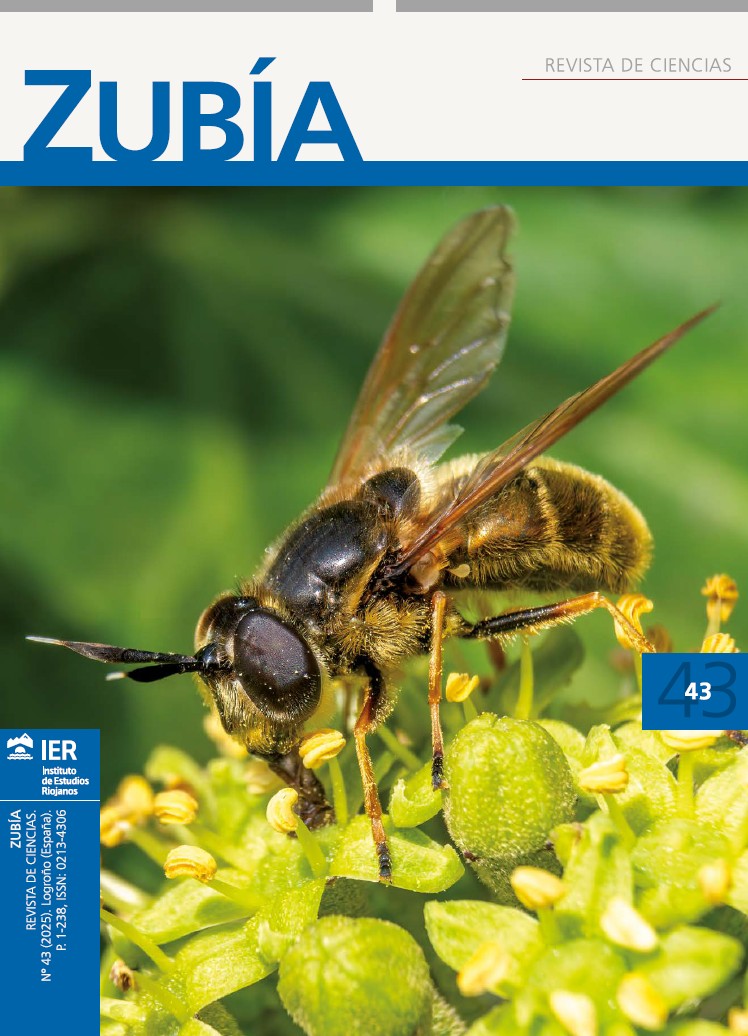
Los sírfidos (Diptera: Syrphidae) de la Reserva de la Biosfera de los valles del Leza, Jubera, Cidacos y Alhama, La Rioja, España
Keywords:
Syrphidae, Conservation, Threat Category, Pollinators, Biocontrol, Biosphere Reserve, La RiojaAbstract
The research carried out to characterize the Syrphidae community in the “Valles del Leza, Jubera, Cidacos, y Alhama” Biosphere Reserve in La Rioja, Spain is presented. The study is funded under the Recovery, Transformation and Resilience Plan and Next Generation funds and was designed with the general objective of preparing an inventory of pollinator insect species and assessing their distribution and phenology in this Biosphere Reserve.
Prior to this publication, there were no bibliographic records on this insect group in the Autonomous Community of La Rioja. The absence of published regional literature on Syrphidae has prevented the availability of a baseline for conducting diversity assessments or detecting changes in population composition.
The Reserve is in the southeastern half of La Rioja and covers an area of 122.811 ha where 21 types of natural habitats of Community interest are represented.
Various sampling methodologies recognized in scientific literature were used, such as bowl traps and sweep transects, conducted both on foot and by vehicle. All collected specimens were sent to the CIBIO Research Institute at the University of Alicante for proper species-level identification.
A total of 870 specimens belonging to 77 species have been identified and are treated individually in their respective records. Of the recorded species, 63 (81,8% of the total) are species recorded here for the first time in La Rioja. Regarding the trophic regime of their immature stages, 41 of the studied species have predatory larvae, mainly feeding on aphids; 14 species are phytophagous, with larvae that can inhabit subterranean plant parts such as bulbs and tubers as well as aboveground tissues; and 22 species have saprophagous larvae that develop in various substrates rich in decomposing plant organic matter, 11 of which are saproxylic species associated with mature trees.
Among the studied species, some are listed with threat categories on the IUCN Red List, thereby evidencing the importance of studying this insect group as well as the advisability and urgency of their conservation.
The greatest activity, both in specimen abundance and species richness, was recorded during May, while zoning of the results allowed highlighting areas of interest, such as the surroundings of Zarzosa, for their high abundance and species richness of syrphids.
This study can be used as a baseline for future studies and serves to highlight the importance of conserving this group of insects that provide generous ecosystem services.
Downloads
References
Agüero, J. I., Rollin, O., Torretta, J. P., Aizen, M. A., Requier, F. y Garibaldi, L. A. (2018). Impactos de la abeja melífera sobre plantas y abejas silvestres en hábitats naturales. Ecosistemas, 27(2): 60–69. doi:10.7818/ECOS.1365
Alba-Tercedor, J., Marcos-García, M. Á. (2024). Revealing the larval anatomy of the hoverfly Sphaerophoria rueppellii (Wiedemann, 1820) (Diptera, Syrphidae) using micro-computed tomography. Scientific Reports, 14: 28848. https://rua.ua.es/dspace/bitstream/10045/149813/1/Alba-Tercedor_Marcos-Garcia_2024_SciRep.pdf
Amorós-Jiménez, R., Pineda Gomez, A.M., Fereres, A., Marcos-García, M.A. (2014). Feeding preferences of the aphidophagous hoverfly Sphaerophoria rueppellii affect the performance of its offspring. BioControl, 59(4): 427-435. https://doi.org/10.1007/s10526-014-9577-8
Amorós-Jiménez, R., Pineda, A., Fereres, A., Marcos-García, M.A. (2012). Prey availability and abiotic requirements of immature stages of the aphid
predator Sphaerophoria rueppellii. Biological Control, 63: 17–24. https://doi.org/10.1016/j.biocontrol.2012.06.001
Bahn, V., Schmidt, V. (2015). Comparative efficiency of Trampas de Bandeja in capturing Syrphidae across diverse habitat types. Journal of Applied Entomology, 139(8): 635–644.
Bartomeus, I., Ascher, J. S., Wagner, D., Danforth, B. N., Colla, S., Minckley, R. (2013). Historical changes in North American bee pollinator communities reveal alterations in diurnal activity peaks. Proceedings of the National Academy of Sciences, 110(30): 12243–12248.
Brehm, G., Hilbig, B. (2013). Evaluation of Trampas de Bandeja for sampling hoverflies (Diptera: Syrphidae) in agricultural landscapes. Bulletin de l’Entomologie, 7(3): 125–131.
Burgio, G., Dindo, M.L., Pape, T., Whitmore, D., Sommaggio, D. (2024). Diptera as predators in biological control: applications and future perspectives. BioControl, 1-17.
Carles-Tolrá, M., Verdugo Páez, A. (2009). Algunos dípteros capturados en el Parque Natural de Los Alcornocales (España, Cádiz) mediante mangueo y trampas (Insecta, Diptera). Boletín de la Sociedad Entomológica Aragonesa, 44: 139–142.
Centro de Estudios y Experimentación de Obras Públicas. (s.f.): Metodología CEDEX para el estudio de comunidades de Insectos. https://www.cedex.es/centros-laboratorios/centro-de-estudios-de-tecnicas-aplicadas-ceta/proyectos/estudios-de-insectos-y
Chittka, L. (1992). The colour hexagon: A chromaticity diagram based on photoreceptor excitations as a framework for colour‐vision research. Journal of Comparative Physiology A, 170(5): 533–543.
Consejo de las Comunidades Europeas. (1992). Directiva 92/43/CEE del Consejo, de 21 de mayo de 1992, relativa a la conservación de los
hábitats naturales y de la fauna y flora silvestres. Diario Oficial de las Comunidades Europeas, L 206, 7–50
Doyle, T., Hawkes, W.L.S., Massy, R., Powney, G.D., Menz, M.H.M., Wotton, K.R. (2020). Pollination by hoverflies in the Anthropocene. Proceedings of the Royal Society B, 287, 20200508.
Dunn, L., Lequerica T., M., Reid, C.R., Latty, T. (2020). Dual ecosystem services of syrphid flies (Diptera: Syrphidae): pollinators and biological control agents. Pest Manag. Sci. ps.5807.
Gobierno de La Rioja – Datos Abiertos Gobierno de La Rioja. (s.f.). Distribución de los hábitats de interés comunitario en La Rioja. Datos Abiertos. Recuperado de https://web.larioja.org/dato-abierto/datoabierto?n=opd-1066
Gobierno de La Rioja – Portal de Medio Ambiente Gobierno de La Rioja. (s.f.). Ecosistemas y hábitats en riesgo en La Rioja. Portal de Medio
Ambiente. Recuperado de https://www.larioja.org/medio-ambiente/es/banco-datos-naturaleza/ecosistemas
Gobierno de La Rioja. (s.f.). Ficha técnica de la Reserva de la Biosfera “Valles del Leza, Jubera, Cidacos y Alhama”. https://www.larioja.org/medio-ambiente/es/reserva-biosfera/informacion-general/reserva-biosfera/ficha-tecnica.
Hawkes, W.L. Doyle, T., Massy, R., Weston, S.T., Davies, K., Cornelius, E., Collier, C., Chapman, J.W., Reynolds, D.R., Wotton, K.R. (2024). The most remarkable migrants systematic analysis of the Western European insect flyway at a Pyrenean mountain pass. Proc. R. Soc. B 291: 20232831. https://doi.org/10.1098/rspb.2023.2831
Heinrich, B. (1979). Bumblebee Economics. Harvard University Press, Cambridge, MA.
Hill, M. O. (1973). Diversity and evenness: A unifying notation and its consequences. Ecology, 54(2): 427–432.
Jost, L. (2006). Entropy and diversity. Oikos, 113(2): 363–375.
Kerr, J. T., Prys, L., y LaSalle, J. (2018). Diurnal flight activity of bee pollinators under varying meteorological conditions. Agriculture and Forest Entomology, 20(1), 56–63.
Kevan, P. G. y Chittka, L. (2001). Psychophysics of the colour vision of hymenopteran insects. Journal of Comparative Physiology A, 187(7), 551–567.
Llandres, A.L. (2011). Interacciones entre arañas cangrejo y polinizadores: estrategias de caza de las arañas cangrejo y estrategias antidepredatorias de los polinizadores. Ecosistemas, 20(2-3): 112-116.
Magurran, A. E. (1989). Ecological Diversity and Its Measurement. Princeton University Press.
Marcos García, M. A. (2021). Experiencia de campo e investigación, un binomio clave para el éxito del control de pulgones por sírfidos (Diptera, Syrphidae). PHYTOMA, 327:40-44.
Marcos-García, M. A., García-López, A., Zumbado, M. A., y Rotheray, G. E. (2012). Sampling methods for assessing syrphid biodiversity (Diptera:
Syrphidae) in tropical forests. Environmental entomology, 41(6): 1544-1552. DOI: http://dx.doi.org/10.1603/EN12215
Martínez‐Falcón, A.P., Ángeles Marcos‐García, M., Díaz‐Castelazo, C., Rico‐Gray, V. (2010). Seasonal changes in a cactus‐hoverfly (Diptera: Syrphidae) network. Ecological Entomology, 35(6): 754-759. https://doi.org/10.1111/j.1365-2311.2010.01236.x
Ministerio de Medio Ambiente, Dirección General de Conservación de la Naturaleza. (2005). Atlas y Manual de los Hábitats de España. Madrid: Ministerio de Medio Ambiente.
Moreno, C. E., Barragán, F., Pineda, E., Pavón, N. P. (2011). Reanálisis de la diversidad alfa: alternativas para interpretar y comparar información sobre comunidades ecológicas. Revista Mexicana de Biodiversidad, 82(4): 1249–1261.
Ohashi, M., Smith, D. R., Brown, K. L. (1994). Weather influences on foraging behavior of honey bees (Apis mellifera) in a temperate region. Journal of Apicultural Research, 33(3): 215–223.
Peet, R. K. (1974). The measurement of species diversity. Annual Review of Ecology and Systematics, 5: 285–307.
Pekas, A., de Craecker, I., Boonen, S., Wäckers, F.L. Moerkens, R. (2020). One stone; two birds: concurrent pest control and pollination services
provided by aphidophagous hoverflies. Biological Control, 149:104328. https://doi.org/10.1016/j.biocontrol.2020.104328.
Pielou, E. C. (1969). An Introduction to Mathematical Ecology. New York, NY: John Wiley y Sons.
Pla, L. (2006) Biodiversidad: inferencia basada en el índice de Shannon y la riqueza. Interciencia, 31(8): 583–590.
Potts, S.G., Roberts, S.P.M., Dean, R., Marris, G., Brown, M., Jones, R., Settele, J. (2010). Declines of managed honeybees and beekeepers in Europe. Journal of Apicultural Research, 49: 15-22.
Reynolds, S.K., Clem, C.S., Fitz‐Gerald, B., Young, A.D. (2024). A comprehensive review of long‐distance hover fly migration (Diptera: Syrphidae). Ecological Entomology, 49 (6): 749-767.
Ricarte Sabater, A. (2008). Biodiversidad de sírfidos (Diptera: Syrphidae) y conservación de los hábitats en el Parque Nacional de Cabañeros, España. Tesis doctoral, Universidad de Alicante.
Ricarte, A., Marcos-García, M.Á. (2017). A checklist of the Syrphidae (Diptera) of Spain, Andorra and Gibraltar. Zootaxa, 4216 (5): 401-440.
Rivas-Martínez, S. (1987). Memoria del mapa de Series de Vegetación de España 1:400.000. ICONA, Serie Técnica: 3-208. Ministerio de Agricultura, Pesca y Alimentación, Madrid.
Rivas-Martínez, S., Penas, A., Asensi, A, M. (2003). Atlas y Manual de los Hábitats de España. TRAGSA. Ministerio de Medio Ambiente de España. Dirección General de Conservación de la Naturaleza, Madrid.
Rojo, S., Gilbert, F., Marcos-García, M.A., Nieto, J.M. Mier, M.P. (2003). A World Review of Predatory Hoverflies (Diptera, Syrphidae: Syrphinae) and their Prey. CIBIO Ediciones, Alicante, 319 pp.
Rotheray, G.E. (1993). Color Guide to hoverfly larvae (Diptera, Syrphidae) in Britain and Europe. Dipterists Digest 9, 156 pp.
Rotheray, G.E., Gilbert, F. S. (2011). The natural history of hoverflies. Wales, UK.
Rotheray, G.E., Gilbert, F. S. (1999). Phylogeny of Palearctic Syrphidae (Diptera): evidence from larvas stages. Zoological Journal of the Linnean Society, 127: 1-112.
Rotheray, G.E., Hancock, G., Hewitt, S., Horsfield, D., MacGowan, I.,
Robertson, D. Watt, K. (2001). The biodiversity and conservation of saproxylic Diptera in Scotland. Journal of Insect Conservation, 5: 77-85.
Ruiz Tutor, J., Gómez Urizarna, S., Fontecha Palacios, R. (2003). Valles del
Leza, Jubera, Cidacos y Alhama: Reserva de la Biosfera. Ministerio para la Transición Ecológica y el Reto Demográfico.
Sánchez Heredia, E. M., Aniorte, N., Ricarte, A., Marcos‐García, M. Á. (2017). Diversidad de sírfidos (Diptera: Syrphidae) de la Estación Biológica de Torretes (Alicante, España). Cuadernos de Biodiversidad, 52: 38–45. doi:10.14198/cdbio.2017.52.06
Shannon, C. E. (1948). A mathematical theory of communication. Bell System Technical Journal, 27(3 y 4): 379–423, 623–656.
Speight, M.C.D. (2008). Species accounts of European Syrphidae (Diptera) 2008. In: Speight, M.C.D, Castella, E., Sarthou, J-P. y Monteil, C. editors. Syrph the Net, the database of European Syrphidae. Syrph the Net publications. Dublin. vol. 55, 261 pp.
Speight, M.C.D., Castella, E. (2008). StN Database: content and glossary of terms, Ferrara, 2006. In: Speight, M.C.D, Castella, E., Sarthou, J-P. y Monteil, C. editors. Syrph the Net. The database of European Syrphidae. Syrph the Net publications. Dublin. Vol. 52, 77 pp.
Speight, M.C.D., Monteil, C., Castella, E. Sarthou, J-P (2008). StN Ferrara 2008. In: Speight, M.C.D, Castella, E., Sarthou, J-P. y Monteil, C. editors.
Syrph the Net on CD, Issue 6. The database of European Syrphidae. ISSN 1649-1917. Syrph the Net publications. Dublin.
Speight, M.C.D., Sarthou, V., Sarthou, J-P. Castella, E. (2007). Le Syrphe, l´ordinateur et la gestión de la biodiversité. Rapport du Conservatoire Départamental des Espaces Naturels de Haute-Savoie (Asters). France, 58 pp.
Thompson, F.C., Rotheray G.E. (1998). Family Syphidae. In: Papp, L., Davas, B. (Eds.), Contributions to a Manual of Paleartic Diptera. Science Herald, Budapest, p. 81-139.
Velasco, A., Moreno, J. (2011). Técnicas de mangueo en el muestreo de dípteros: aplicaciones en Syrphidae. Revista de Entomología Agrícola, 8(1): 45–53.
Vujić, A., Gilbert, F., Flinn, G., Englefield, E., Ferreira, C.C., Varga, Z., Eggert, F., Woolcock, S., Böhm, M., Mergy, R., Ssymank, A., van Steenis, W., Aracil, A., Földesi, R., Grković, A., Mazanek, L, Nedeljković, Z., Pennards, G.W.A., Pérez, C., Radenković, S., Ricarte, A., Rojo, S., Ståhls, G., van der Ent, L.-J., van Steenis, J., Barkalov, A., Campoy, A., Janković, M., Likov, L., Lillo, I., Mengual, X., Milić, D., Miličić, M., Nielsen, T., Popov, G., Romig, T., Šebić, A., Speight, M., Tot, T., van Eck, A., Veselić, S., Andric, A., Bowles, P., De Groot, M., Marcos-García, M.A., Hadrava, J., Lair, X., Malidžan, S., Nève, G., Obreht Vidakovic, D., Popov, S., Smit, J.T., Van De Meutter, F., Veličković, N., Vrba J. (2022). Pollinators on the edge: our European hoverflies. The European Red List of Hoverflies. Brussels, Belgium: European Commission.
Westphal, C., Bommarco, R., Carre, G., Lamborn, E., Morison, N., Petanidou, T., Steffan-Dewenter, I. (2008). Measuring bee diversity in different habitats: a comparison of Trampas de Bandeja, transect walks, and net sampling. Journal of Insect Conservation, 12(2): 157–167.
Willmer, P. G. (1983). Temperature and the flower‐visiting activities of bees. Environmental Entomology, 12(2): 232–237.
Wong, D., Norman, H., Creedy, T. J., Jordaens, K., Moran, K. M., Young, A., Mengual, X., Skevington, J. H., Vogler, A. P. (2023). The phylogeny and evolutionary ecology of hoverflies (Diptera: Syrphidae) inferred from mitochondrial genomes. Mol Phylogenet Evol., 184: 107759. https://doi.org/10.1016/j.ympev.2023.107759
Wotton, K. R., Gao, B., Menzels, J., Cui, J., Hu, G., Reynolds, D. R., Chapman, J. W. (2019). Mass seasonal migrations of hoverflies provide extensive pollination and crop protection services. Current Biology, 29(13): 2167–2173.e4.
Young, A.D., García, M.R., Viejo, J.L. (2023). Preliminary results of insect community monitoring in a suburban stretch of the Manzanares river (Madrid). XX Congreso Ibérico de Entomología. Alicante.
Zaldívar-López, R., Alonso León, A., y Esquisabel, J. I. Zaldívar-López, R., Alonso León, A., y Esquisabel, J. I. (s.f.). Revisión de la cartografía de los hábitats naturales de interés comunitario en La Rioja. Ministerio para la Transición Ecológica y el Reto Demográfico. Recuperado de https://www.miteco.gob.es/content/dam/miteco/es/biodiversidad/formacion/hic_rioja_r_zaldivar_tcm30-503383.pdf.
Downloads
Issue
Section
License
Copyright (c) 2025 Zubía

This work is licensed under a Creative Commons Attribution-NonCommercial-ShareAlike 4.0 International License.
Los autores que publican en Zubía conservan los derechos de autor de sus trabajos y autorizan a la revista la primera publicación de los mismos.
Los artículos se publican bajo la licencia Creative Commons Atribución–No Comercial–Compartir Igual (CC BY-NC-SA), que permite su uso, distribución y reproducción en cualquier medio, siempre que se cite adecuadamente la autoría original, no se realice un uso comercial y se mantenga la misma licencia.